We started grading MPP endpoints. Here's what 1,226 of them look like.
By Elijah Cordova · · 6 min read
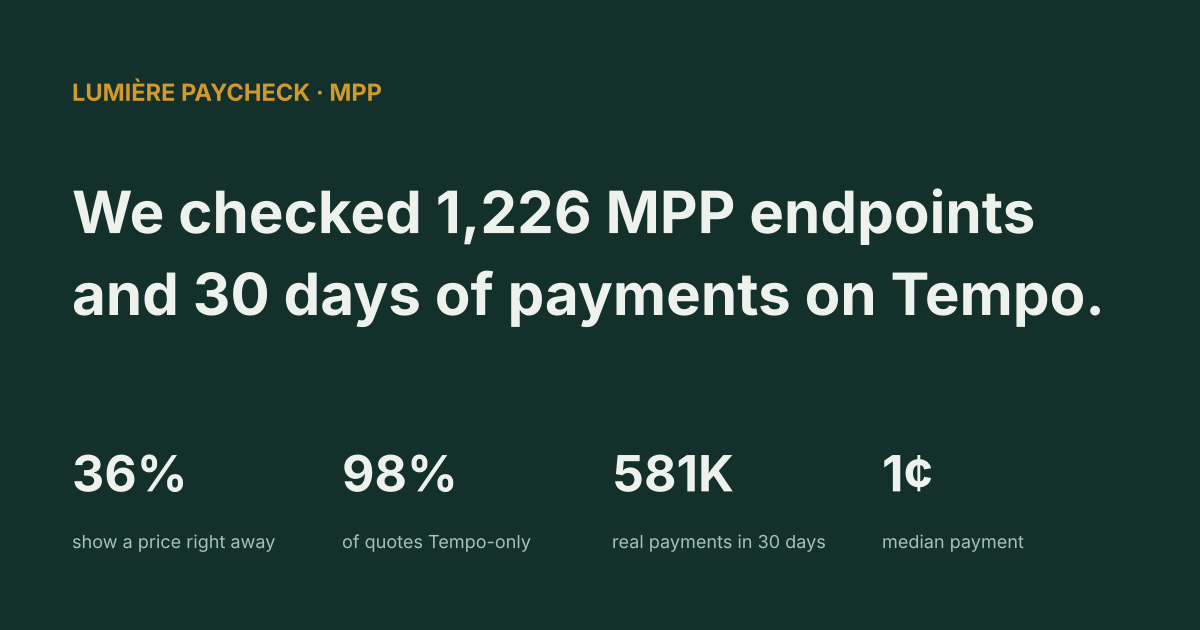
Agents can now pay for APIs two ways: x402, and MPP, the Machine Payments Protocol from Tempo and Stripe. Lumière PayCheck has graded x402 sellers for months. This week we added MPP: the endpoints in the public MPP catalog are now monitored and graded the same way, with the same public rules, and real MPP payments now count in our usage data alongside x402.
Before the grades fill in, we wanted a first look. So we sent one unpaid request to every MPP endpoint we could call, the same request our monitor sends, and read what came back. Then we read 30 days of real MPP payments straight from the Tempo chain.
What we checked
The MPP catalog lists 142 services and 1,619 endpoints. 1,226 of them are concrete routes we can call. The rest are templates like /items/:id that need real values, or entries that aren't priced.
For each one we asked: does it answer with a payment quote, can an agent actually read that quote, what does it cost, and how can it be paid?
What we found
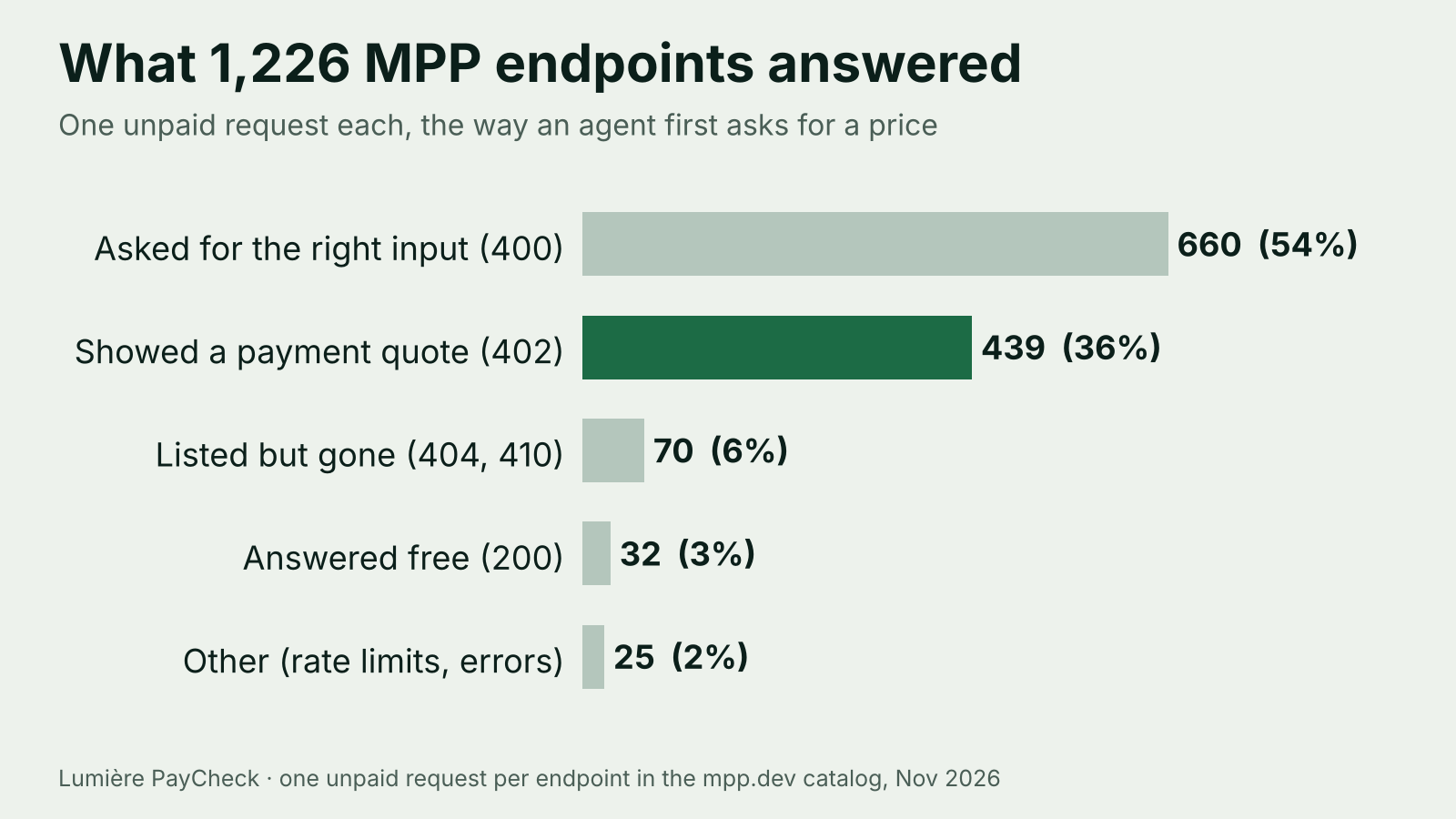
About a third show a price right away. 439 endpoints (36%) answered with a 402 and a payment quote. 392 of those were valid MPP quotes an agent can read and pay, across 57 services.
Over half want the right input first. 660 endpoints (54%) answered 400 to a bare request. That isn't necessarily broken. Many APIs check the request before they quote a price. But it means an agent can't see what a call costs until it sends exactly the right input, and a catalog listing alone doesn't tell it what that is.
Some listings point nowhere. 70 endpoints (about 6%) answered 404 or 410: listed in the catalog, gone from the server.
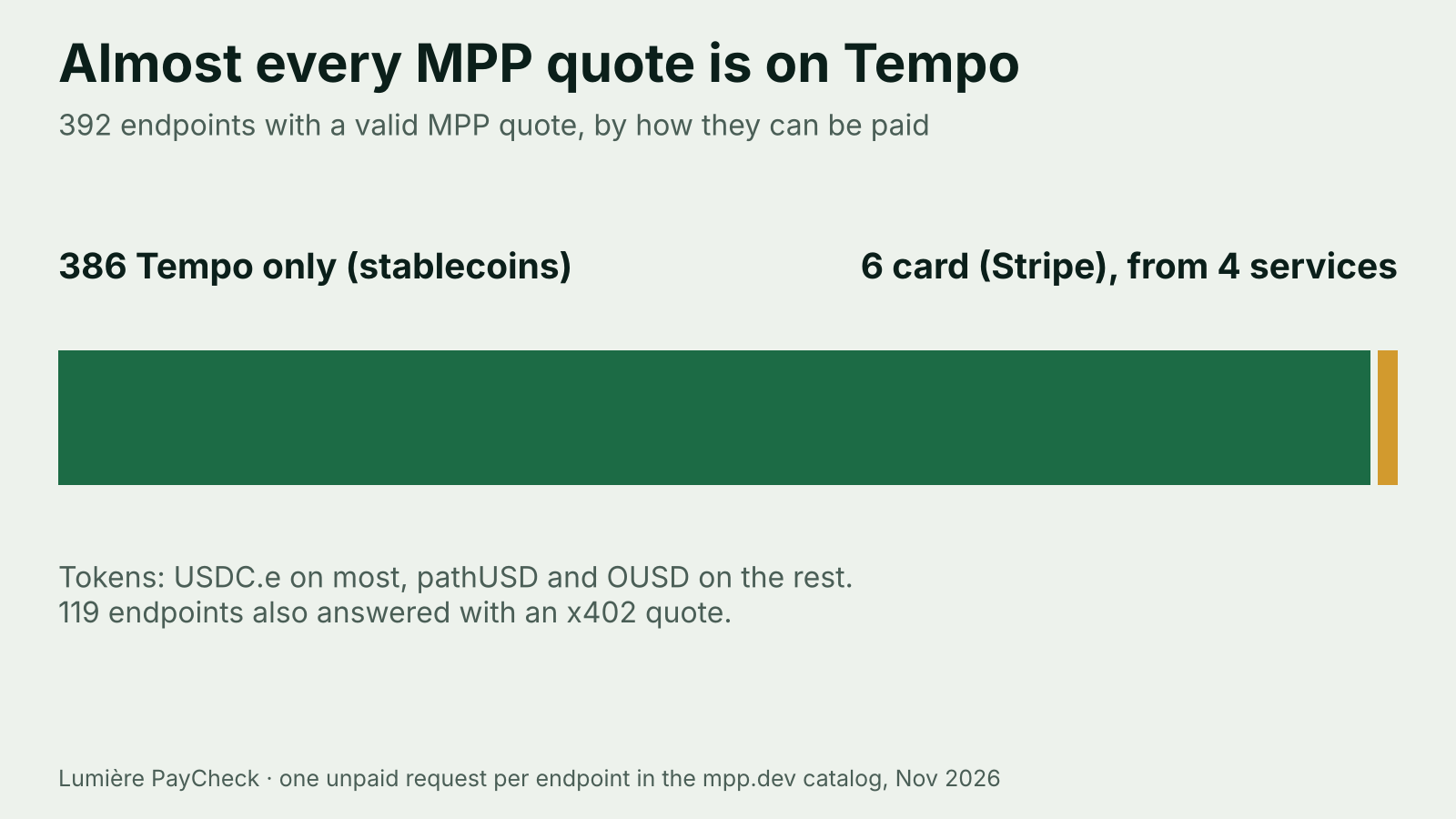
It's a Tempo network, for now. 386 of the 392 valid quotes are Tempo-only. Payment is in USDC.e for most, with pathUSD and OUSD on the rest. Only 6 endpoints, from 4 services, offer card payment through Stripe.
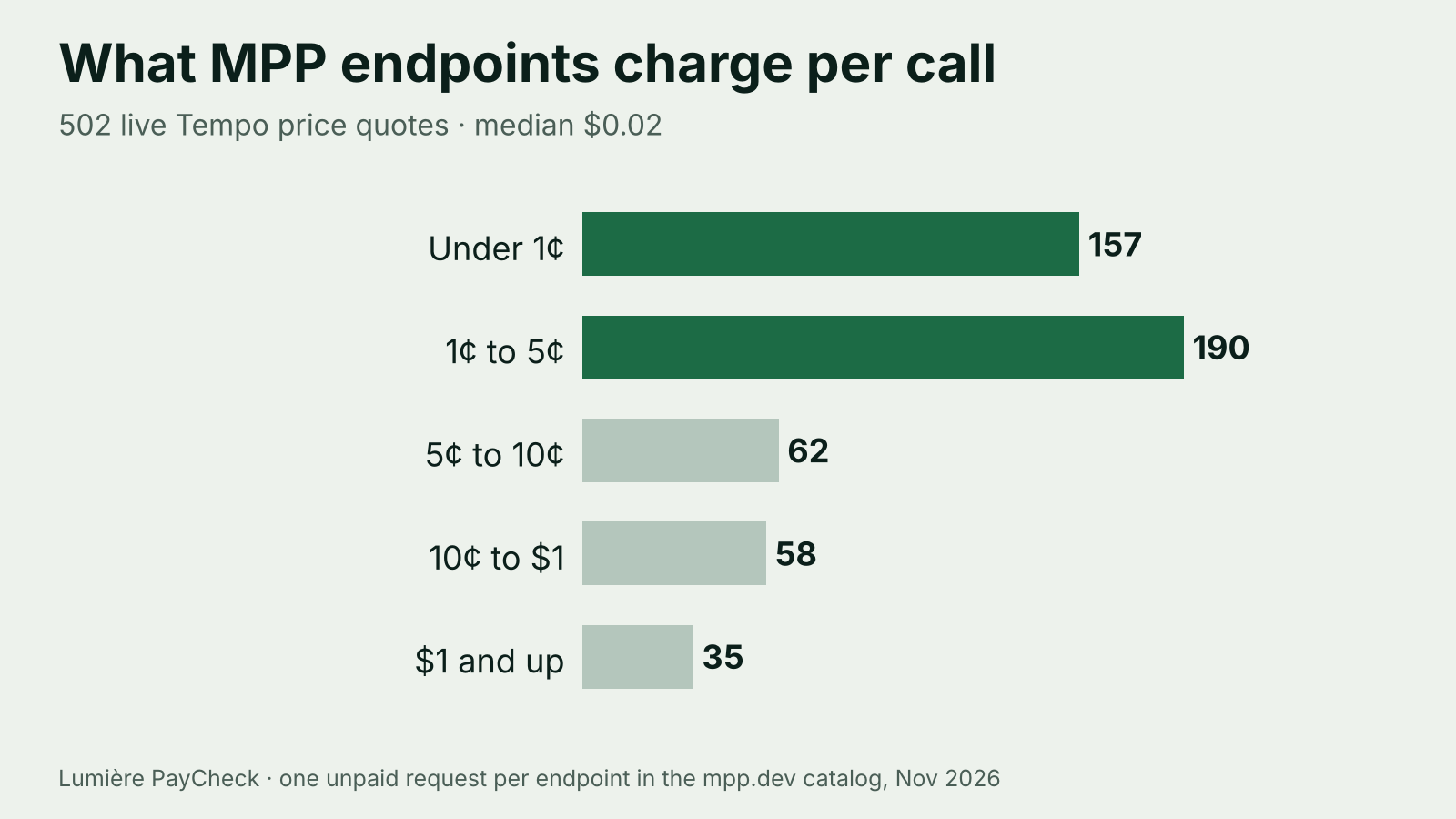
It's cheap. The median price is $0.02. 31% cost under a cent, and 90% cost under $0.55. 35 endpoints charge $1 or more, up to $20.
Quotes expire fast. The typical MPP quote is valid for 5 minutes. That's good for safety, since an old quote can't be replayed, but an agent has to pay soon after it asks.
The catalog and the server mostly agree. For 442 priced quotes we could compare, 20 had a live price different from the catalog listing. That's why we grade the live 402, never the catalog copy.
Many speak both protocols. 119 endpoints answered with an MPP quote and an x402 quote at the same time. One more reason a trust check should cover both.
Real money is already moving
Listings are one thing. Payments are another. Every MPP payment on Tempo made with the official SDK (mppx, by wevm) carries an on-chain tag, so real API payments can be told apart from ordinary transfers. We read them straight from the chain.
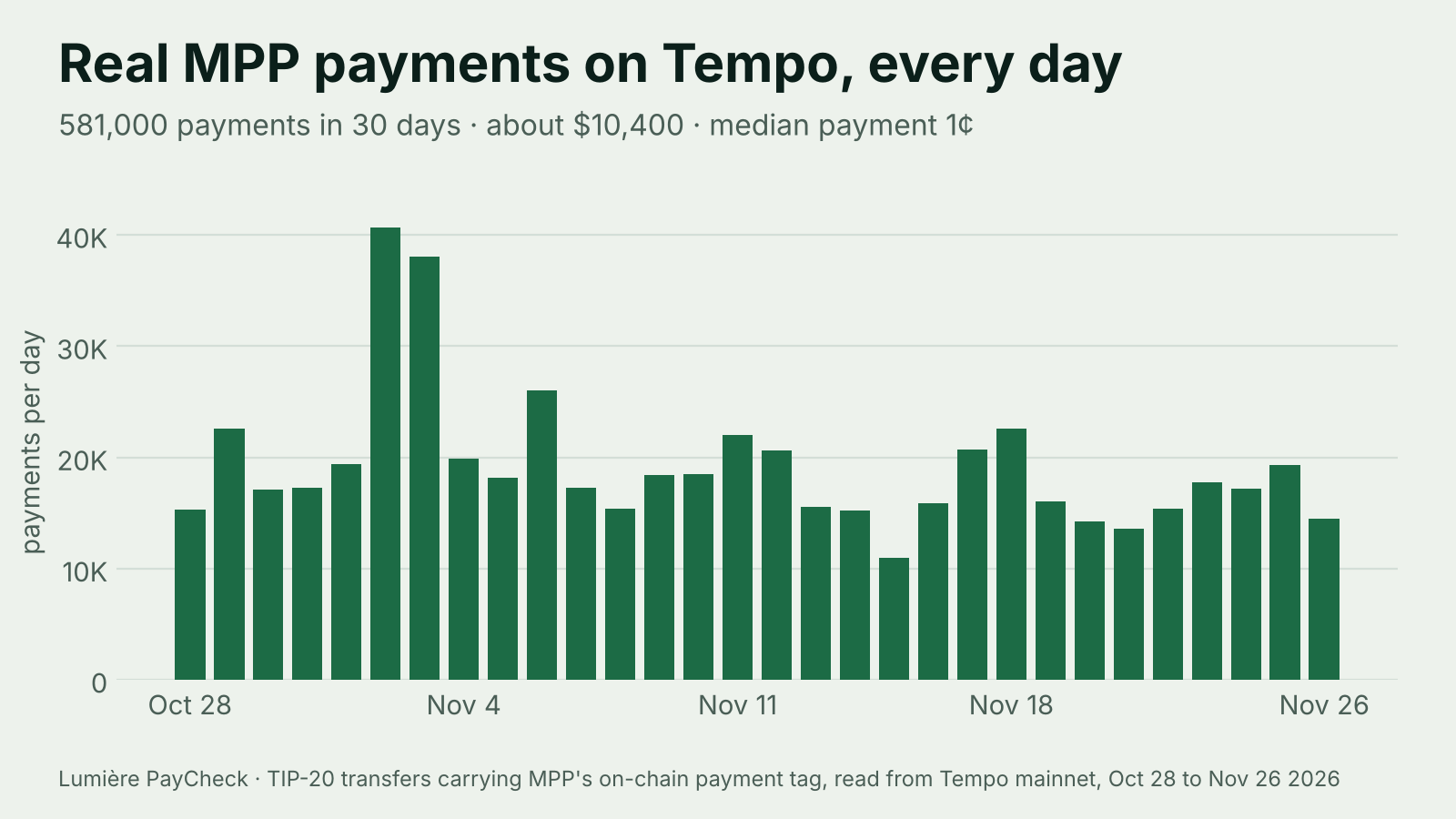
In the last 30 days (Oct 28 to Nov 27):
- 581,000 tagged MPP payments on Tempo, worth about $10,400
- from about 10,600 buyer addresses
- a median payment of 1 cent, and an average under 2 cents
- a steady 15,000 to 20,000 payments on most days
Small amounts, lots of calls. That's what agent payments look like when they work.
The money is concentrated, though. Payments went to about 8,000 receiving addresses, but the top 10 took 87% of the volume. A few services carry most of MPP today.
These payments are now part of "Real money, measured" on our homepage, next to Base, Solana and Keeta. They're counted by the same rules as x402: only real API payments count, and buyers funded from the same source count as one buyer, so a seller paying itself through a pile of wallets doesn't look like demand.
The card payment problem
Cards are the part of MPP that looks easiest and works least smoothly for agents today.
A person has to approve every card payment. When an agent pays with a card through Link, Stripe's agent wallet, each payment is a spend request that someone approves in the Link app, and the approval expires after 30 minutes. That's a sensible protection for a card. But it means a card-paying agent isn't fully autonomous. Someone has to be around to tap approve.
Small payments don't fit card economics. The cheapest card endpoints we found charge $0.01 a call. Stripe won't take a card charge under $0.50, and every card charge has a processing fee. So when a seller pays us by card to test a $0.01 endpoint, the seller pays $1.00: Stripe's $0.50 minimum plus a $0.50 processing fee. Stablecoins on Tempo don't have that problem. A test of a $0.01 Tempo endpoint costs $0.015 including the network fee.
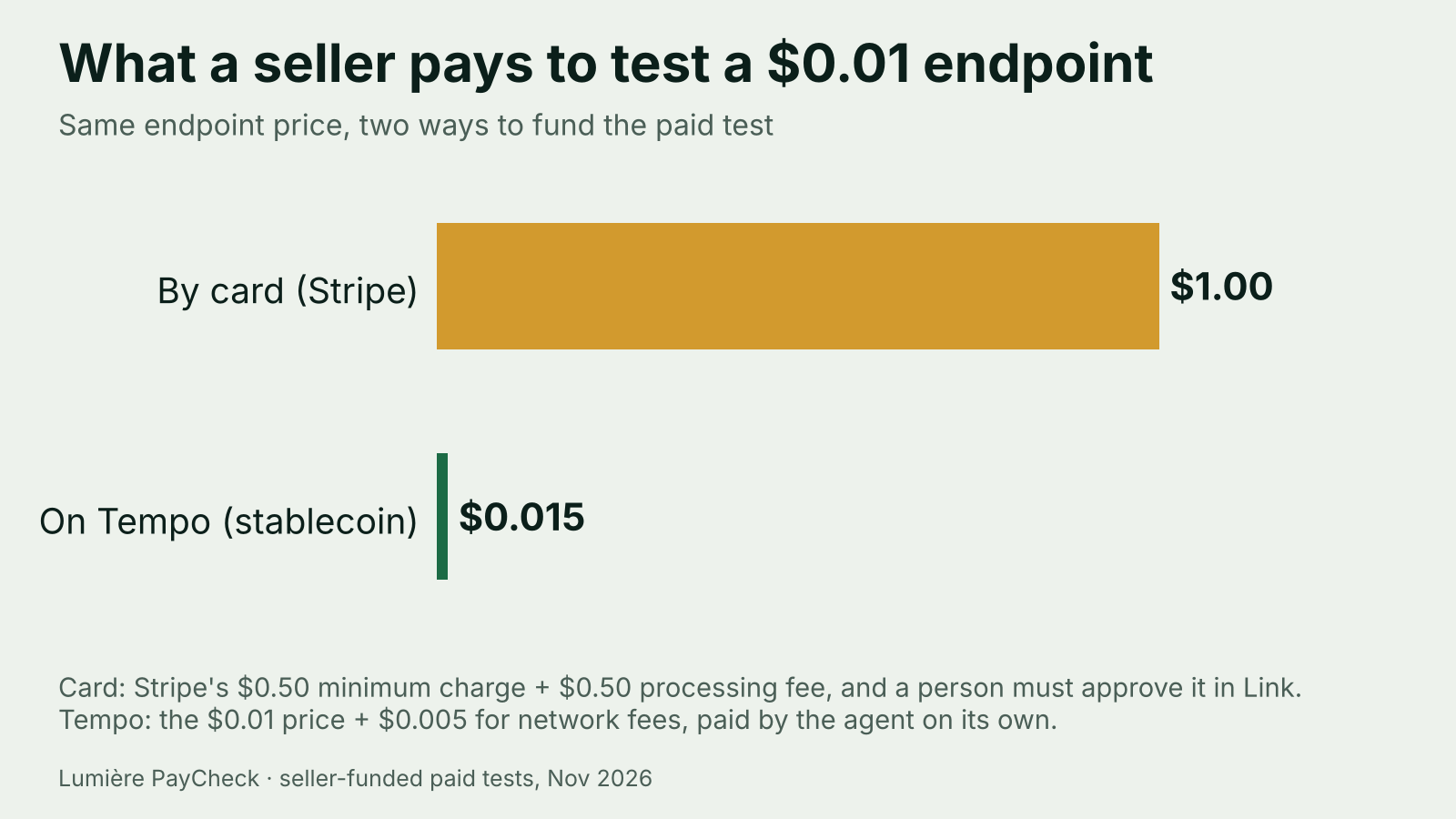
Refunds can't return the fee. If a card test can't run (the payment isn't approved in time, the endpoint changes its price, or it stops asking for card payment), we refund the test price, but not the processing fee. Stripe keeps its fee on every card charge, refunded or not.
None of this is a flaw in MPP. It's what happens when you put a card under a machine payment. For now, Tempo is where agent payments actually run on their own, and the numbers above show it: half a million payments in a month, at about a cent each.
How grading works for MPP
The rules are the same as for x402:
- We check every endpoint regularly without paying, and record its price, payout address and token.
- A changed payout address, a price far above normal, or a token the endpoint doesn't usually take gets flagged before an agent pays.
- An A or B needs a real paid test that delivered.
We don't pre-fund MPP tests. If you run an MPP endpoint and want the paid test, you fund it:
- On Tempo: pay the test with any MPP client, in your endpoint's own token. Our Tempo tester then pays your endpoint that same amount, so the money goes to your own payout address. The grade comes only from what the test finds.
- By card: pay the test price through Stripe checkout. Our Link wallet then pays your endpoint, after a human approves it. If it can't run, the test price is refunded.
If you run an MPP endpoint
A few things that make an endpoint easier for agents to pay, and easier to grade:
- Quote before you validate, or say in your catalog listing exactly what input is required. Agents compare prices before they decide.
- Keep your catalog price current. Agents and directories read it first.
- Remove listings for routes you've retired.
- If you take both x402 and MPP, keep the prices and payout addresses consistent across them.
Check your endpoint free, or read how PayCheck handles MPP.
---
*Method: one unpaid request per endpoint in the mpp.dev catalog (GET, or POST with an empty JSON body, as listed), sent this week from a single location. A 400 means the server rejected that request, not that the endpoint is broken. Prices come from the live 402 responses. Payment figures are TIP-20 stablecoin transfers on Tempo mainnet carrying MPP's attribution tag, Oct 28 to Nov 27, 2026; payments from an address to itself are excluded. Grades on lumierepaycheck.org fill in as our regular checks build up history.*
More from the blog
OpenAI Alternatives on x402: How to Check an AI API Before Your Agent Pays
More AI model APIs now sell by the call over x402: text generation, image generation, embeddings, speech. No account, no API key, no monthly plan. Your…
What Happens When an x402 Payment Fails
When an x402 payment fails, what happens to your money depends on where it failed. If the seller rejects the payment, nothing settles and you keep your…
How to Retry an x402 Request Without Paying Twice
To retry an x402 request without paying twice, resend the same signed payment instead of signing a new one. An x402 payment is a signed authorization with a…